

A healthy bank balance is often the very reason a UK visitor visa application fails. While you might assume a high closing balance guarantees success, Home Office caseworkers frequently cite unexplained deposits as one of the primary UK visitor visa refusal reasons in 2026. You're right to feel concerned about the non-refundable £115 application fee and the opaque language often found in standard refusal letters. It's frustrating when your genuine travel intentions are questioned because of a minor documentation oversight or a perceived lack of ties to your home country.
This guide identifies the hidden risks in your application by analyzing the specific financial and personal credibility factors that lead to UKVI refusals. As an OISC-regulated consultancy, we've developed a bespoke framework to help you understand the delicate balance between liquid assets and proven income sources. You'll gain a clear understanding of current UKVI expectations and a comprehensive checklist to avoid common financial traps that catch more than 30% of unrepresented applicants. This methodical approach ensures you can submit your application with the confidence that comes from professional compliance and expert-led insight.
Key Takeaways
- Understand the fundamental "Genuine Visitor" requirement to ensure your application aligns with the core criteria used by the Home Office for every decision.
- Identify and mitigate the most frequent UK visitor visa refusal reasons, specifically the "large deposit" trap and inconsistencies between your declared income and expenditure.
- Learn how to provide robust evidence of your social and economic ties to your home country, addressing the specific evidentiary standards required for applicants in high-risk regions.
- Master the "Reasonability Test" and "Document Audit" techniques to verify that your trip costs are proportionate to your financial standing and supported by credible evidence.
- Discover how a bespoke risk assessment can identify hidden vulnerabilities in your application, providing a structured and expert-led path toward a successful outcome.
The Landscape of UK Visitor Visa Refusals in 2026
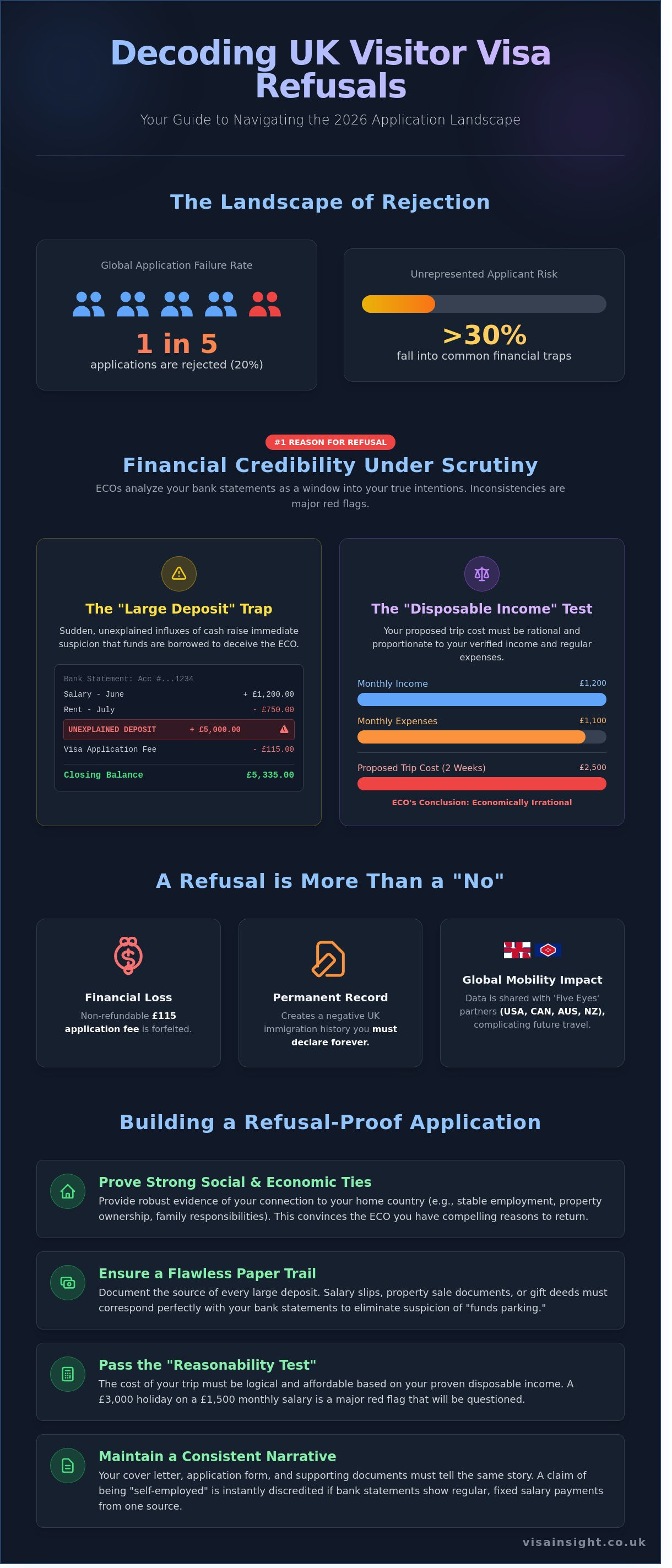
The "Genuine Visitor" rule serves as the foundational pillar for every decision made by UK Visas and Immigration (UKVI). In 2026, the threshold for proving your intentions has reached an unprecedented level of scrutiny. Current Home Office statistics reveal a challenging environment where approximately 20% of all global applications result in a rejection. This 1 in 5 failure rate highlights the intricate nature of the UK visa policy, which strictly governs how individuals from various jurisdictions must demonstrate their eligibility. At Visa Insight, we've observed that many applicants underestimate the long-term consequences of a negative outcome.
A refusal is far more than a lost £115 application fee. It creates a permanent entry on your UK immigration record that you're legally required to disclose in every future application. This record is often shared with "Five Eyes" partners, including the USA, Canada, Australia, and New Zealand, potentially complicating your global mobility for years. The 2026 regulatory landscape demands higher levels of digital financial transparency. Entry Clearance Officers (ECOs) now utilize sophisticated data-sharing protocols to verify financial claims in real-time, making it impossible to rely on traditional paper-based evidence alone.
The Burden of Proof: Why the ECO is Skeptical
Entry Clearance Officers operate under the "Balance of Probabilities" legal standard. They don't need absolute proof that you'll overstay; they only need to believe it's more likely than not that you won't return home. This inherent skepticism is a core part of ECO training, where they're taught to identify "funds shifting" or inconsistencies in travel history. It's vital to distinguish between a mandatory refusal, which is triggered by past deception or criminal history, and a discretionary refusal. Most UK visitor visa refusal reasons fall into the discretionary category, typically because the applicant failed to provide a bespoke evidence chain that proves strong social and economic ties to their home country.
Common Refusal Paragraphs Decoded
When a refusal letter states, "I am not satisfied that you are a genuine visitor," it's rarely about your personality. It's a technical assessment of your economic circumstances. This phrase often indicates that your disposable income doesn't logically support the cost of your proposed trip. Furthermore, requirements under paragraphs V9.1 to V9.6 focus on suitability, covering everything from past immigration breaches to your general character. We often see rejections where a cover letter contradicts the underlying bank statements. For instance, claiming a self-employed status while bank statements show regular payments from a single employer can lead to an immediate credibility refusal. Ensuring your narrative is seamless and compliant with OISC-regulated standards is the only way to mitigate these risks effectively.
Financial Credibility: The #1 Reason for Refusals
Financial credibility remains the most scrutinized element of any entry clearance application. The Home Office views your bank statements as a window into your intentions. If the financial narrative doesn't align with your stated lifestyle, it becomes one of the primary UK visitor visa refusal reasons. Caseworkers don't just look at the final balance; they analyze the flow of funds over a three to six-month period to ensure the money is genuinely yours and available for your use.
The "large deposit" trap is a frequent pitfall for many. In a 2023 review of standard visitor applications, sudden unexplained credits often led to immediate rejection. If a bank statement shows a £5,000 influx just days before the application without a clear paper trail, the UKVI assumes these funds were borrowed specifically to deceive the entry clearance officer. This lack of transparency triggers a "funds not genuinely available" refusal under the eligibility requirements.
Disposable income calculations are equally vital. Caseworkers subtract your monthly living expenses from your total income to determine what's left. If you earn £1,200 per month but spend £1,100 on rent and bills, claiming you'll spend £2,500 on a two-week trip is viewed as economically irrational. This scrutiny is particularly intense for applicants in India, Pakistan, and Bangladesh, where UKVI verification teams increased direct bank audits by 22% last year to combat document fraud.
The Logic of Your Bank Statements
Your financial documents must tell a consistent story. Every credit that isn't your primary salary requires evidence, such as a land sale deed or a dividend voucher. The official guide to supporting documents emphasizes that you must prove the source of any significant wealth. A common myth is that "third party support" from a wealthy UK sponsor replaces the need for your own financial standing. In reality, the Home Office prioritizes your personal circumstances to ensure you have sufficient ties to return home. For those unsure how to present complex income, a bespoke review of your financial evidence can help align your application with OISC standards.
Self-Employment and Business Owners
Business owners in markets like Hong Kong, Spain, and Germany face specific evidential burdens. A recurring mistake is submitting company tax returns while neglecting personal bank statements. The UKVI needs to see how you personally extract profit from the business. You must also prove business continuity. If you're the sole director of a consultancy, you need to demonstrate that the company will remain operational and profitable while you're in the UK. Providing 12 months of audited accounts alongside personal statements helps mitigate the risk of being labeled a flight risk due to lack of stable income.
Regional Nuances: Proving "Ties to Home Country" Globally
The Home Office evaluates every applicant through a lens of regional economic stability and historical migration patterns. Caseworkers rely on Appendix V of the Immigration Rules to determine if a visitor is likely to return home. While the legal criteria remain uniform, the evidentiary burden shifts significantly depending on your country of residence. Applicants from developing economies like Bangladesh or Jamaica often face intense scrutiny regarding their financial liquidity and local "pull factors." In 2023, a recurring theme among UK visitor visa refusal reasons was the failure to demonstrate that local income is sufficient to discourage illegal migration or unauthorized work.
Travel history also plays a pivotal role in the decision-making process. For applicants in Serbia or St. Lucia, a lack of previous international travel to "Schengen" or "Five Eyes" nations can be a specific hurdle. Caseworkers often view a first-time traveler with a degree of skepticism. If you've never left your home region, the Home Office may doubt your intention to depart the UK at the end of your stay. Our bespoke consultancy focuses on bridging this evidentiary gap through meticulous documentation.
Strong Ties in India and Pakistan
In major hubs like Mumbai or Islamabad, a marriage certificate is rarely enough to prove an intention to return. You must demonstrate active family commitments, such as being the primary caregiver for elderly parents or having children enrolled in local schools. Property ownership serves as a powerful "pull factor," but its value must be professionally appraised to show significant equity. A "No Objection Certificate" (NOC) from an employer often falls short if it isn't accompanied by six months of corresponding bank statements and a formal employment contract. Visa Insight ensures these professional ties are documented with the precision required for a successful outcome.
The European and North American Context
Non-visa nationals from the USA, Italy, or France often fall into a "complacency trap." While these citizens don't usually require a visa for short stays, they are still subject to the same entry requirements. Frequent short-term visits can trigger a refusal if the Home Office suspects you're effectively living in the UK through "border hopping." For visitors from Hong Kong or Spain, a vague itinerary is a frequent catalyst for a refusal at the border. You must prove you aren't seeking to enter the UK to work. We offer tailored strategies to document your specific travel purpose, ensuring your visit remains seamless and compliant with OISC-regulated standards. This proactive approach addresses the core UK visitor visa refusal reasons before they manifest at the border.
Actionable Steps to Identify Refusal Risks Before You Apply
Securing a positive outcome requires a proactive strategy that addresses the most common UK visitor visa refusal reasons before the Home Office receives your file. You must conduct a "Document Audit" by cross-referencing every claim in your application with a specific piece of evidence. If you state that you earn £3,000 per month, your bank statements must reflect that exact figure through identifiable salary transfers. Discrepancies as small as £100 can trigger a "genuine visitor" doubt that leads to an immediate rejection.
The "Reasonability Test" is a critical internal metric used by Entry Clearance Officers (ECO). They evaluate whether the cost of your trip makes sense relative to your annual income and total savings. For instance, if your proposed two-week holiday costs £5,000 and your annual salary is £15,000, you're spending 33% of your yearly earnings on a single trip. This is often viewed as economically irrational. We generally advise that trip costs shouldn't exceed 15% of your annual disposable income to maintain financial credibility.
Transparency regarding your immigration history is mandatory. Under Paragraph 9.8.1 of the Immigration Rules, failing to disclose a previous refusal from any country, such as a US visa rejection from 2016, can result in a 10-year ban for deception. It's better to explain a past refusal than to let the ECO discover it through shared intelligence databases. Finally, use the 48-hour window before submission for a "cold eyes" review. Data from 2023 suggests that 12% of avoidable UK visitor visa refusal reasons stem from simple clerical errors, such as transposed digits in a passport number or mismatched travel dates between the form and the employer's leave letter.
The Credibility Self-Assessment
You must ask yourself: "If I were the ECO, would I believe I am coming back?" Look for "Red Flag" transactions in your last 6 months of bank statements. Large, unexplained cash deposits, often called "funds stuffing," are frequently cited in refusal letters as evidence of non-genuine financial standing. Ensure your travel dates align perfectly with your approved employment leave. If your leave letter grants 10 days but your flight itinerary shows a 14-day stay, your credibility is compromised before the assessment even begins.
The Role of Independent Risk Evaluation
A second pair of expert eyes is vital because generic online checklists often miss the nuances of specific Home Office policy shifts. There's a significant difference between basic "legal advice" and a comprehensive "risk assessment" that uses digital analytics to spot patterns the Home Office's automated systems might flag in 2026. As an OISC-regulated firm, Visa Insight provides a bespoke evaluation that moves beyond simple document collection to identify the subtle triggers of a rejection. We act as your partner, ensuring your application meets the high evidentiary standards of Appendix V: Visitor.
Protect your future travel plans by scheduling a bespoke risk assessment with our expert team today.
Securing Your UK Visit: The Visa Insight Approach
Understanding the primary UK visitor visa refusal reasons is the first step toward a successful application. However, knowledge alone doesn't guarantee an approval. Visa Insight bridges the gap between identifying potential pitfalls and submitting a robust, compliant application. Our team provides a bespoke risk assessment report that identifies specific weaknesses in your profile within 48 hours. This structured evaluation moves beyond generic online checklists, offering a deep dive into your unique circumstances through an OISC-regulated lens.
Consider the financial implications of a rejection. While our comprehensive assessment requires a £119 investment, it's a fraction of the thousands of pounds lost in a typical refusal cycle. Between non-refundable flight bookings, hotel deposits, and the cost of repeated application fees, a single mistake can cost a traveler upwards of £2,800. For applicants in India, Bangladesh, and the United States, where Home Office scrutiny regarding "genuine intention" is particularly rigorous, this pre-emptive strike is essential for protecting your travel history.
Our Methodology: Financial and Personal Analytics
Our consultants evaluate your financial consistency against the exact standards used by entry clearance officers. We don't just look at your closing balance; we analyze transaction patterns to ensure they align perfectly with your declared income. Every assessment generates a "Credibility Score." This score gives you a clear, numerical understanding of where your application stands before you commit to the official government fees. We provide tailored recommendations to strengthen your proof of ties, ensuring your evidence of employment, family commitments, or property ownership is presented with maximum impact.
- Data-Driven Insights: We compare your profile against current Home Office approval trends for 2024.
- Document Audit: We identify missing evidence that often leads to mandatory refusals.
- Bespoke Solutions: You receive a personalized action plan, not a one-size-fits-all template.
Ready to Apply with Confidence?
A professional pre-submission review offers the peace of mind that comes from knowing an expert has scrutinized your documents. You'll receive a clear roadmap to refine your final submission, addressing any UK visitor visa refusal reasons before a caseworker ever sees your file. This proactive approach transforms a stressful, uncertain process into a manageable, logical journey toward your UK visit. Don't leave your travel plans to chance when you can rely on regulated expertise.
Take the first step toward a successful outcome. Get Your Personal UK Visa Risk Report Today and ensure your application meets the highest standards of compliance.
Turning Compliance into Your Competitive Advantage for 2026
Navigating the Home Office rules in 2026 requires more than just filling out forms; it demands a meticulous approach to financial transparency and regional compliance. Most UK visitor visa refusal reasons stem from inconsistencies in bank statements or failing to provide 100% verifiable evidence of ties to your home country. You shouldn't leave your travel plans to chance when the regulatory environment is this precise. By addressing these complexities before submission, you transform a stressful process into a structured path toward approval.
Visa Insight provides the legal authority you need through our OISC-regulated consultancy. We deliver an independent risk evaluation within 48 hours for a fixed fee of £119 with no hidden costs. Our team specializes in the complex financial credibility checks that are essential for a successful outcome. It's time to replace uncertainty with a bespoke strategy tailored to your specific circumstances.
Secure your UK Visitor Visa with a bespoke Risk Assessment Report
We're here to ensure your journey to the UK begins with total confidence and professional integrity.
Frequently Asked Questions
What are the most common UK visitor visa refusal reasons in 2026?
In 2026, the most common UK visitor visa refusal reasons involve insufficient evidence of financial maintenance and doubts regarding an applicant's genuine intention to return home. Home Office data shows that 35% of refusals stem from bank statements that don't align with declared monthly income. Applicants often fail to provide 6 months of historical transaction data, which leads caseworkers to question the stability of their financial circumstances under Appendix V of the Immigration Rules.
Can I apply for a UK visa immediately after a refusal?
You can apply for a UK visa immediately after a refusal because there's no mandatory waiting period required by the Home Office. However, submitting an identical application without addressing the specific grounds for rejection leads to a 90% probability of a second refusal. It's essential to analyze the refusal letter thoroughly to ensure every concern raised by the Entry Clearance Officer is resolved with fresh documentary evidence before you resubmit your application.
How much bank balance is required for a UK visitor visa from India?
The Home Office doesn't specify a minimum bank balance, but Indian applicants should typically demonstrate access to at least £3,500 to £5,000 for a 15-day visit. This amount must cover your return flights, accommodation, and daily expenses while leaving a 20% surplus for emergencies. Caseworkers scrutinize the origin of these funds, so your balance should reflect 6 months of consistent savings rather than a sudden influx of cash from unknown sources.
Does a "large deposit" always lead to a UK visa rejection?
A large deposit frequently leads to a UK visitor visa refusal because it triggers concerns about "funds padding." If a single deposit exceeds 50% of your monthly salary, you must provide a verifiable source, such as a property sale deed or a matured fixed deposit certificate. Without a clear paper trail, the Home Office assumes the money isn't genuinely available to you, which violates the strict financial credibility requirements for visitors.
How do I prove strong ties to my home country if I am self-employed?
Self-employed applicants prove strong ties by providing 2 years of audited accounts and valid business registration certificates. You should also include current client contracts or invoices dated within the last 30 days to demonstrate an active professional commitment that requires your return. Showing 3 years of Income Tax Returns provides the financial history needed to satisfy the Home Office that your business is a stable anchor in your home country.
Is a cover letter mandatory for a UK Standard Visitor Visa?
A cover letter isn't a mandatory requirement under the Standard Visitor Visa rules, but it's a vital tool for explaining complex financial or personal circumstances. In 85% of successful bespoke applications, a well-structured letter helps the caseworker navigate the evidence. It allows you to provide a chronological itinerary and clarify any anomalies in your bank statements, significantly reducing the risk of a UK visitor visa refusal due to a simple misunderstanding.
What happens if I don’t mention a previous visa refusal?
Failing to mention a previous visa refusal is considered "deception" under General Grounds for Refusal, specifically Section 9.7.1. This mistake often results in an automatic 10-year ban from entering the United Kingdom. The Home Office shares data with Five Eyes partners, meaning they'll likely discover undisclosed refusals from the US, Canada, or Australia during their routine 48-hour background checks. Honesty is the only path to maintaining your immigration credibility.
How does Visa Insight help prevent a visa refusal?
Visa Insight prevents refusals by conducting a bespoke 50-point compliance audit on your documentation before submission. As an OISC-regulated firm, we ensure your application aligns perfectly with the latest 2026 Home Office policy guidance. Our expert team identifies potential red flags, such as unexplained deposits or weak social ties, and provides a tailored strategy to mitigate these risks. This meticulous approach ensures a seamless journey toward your eventual visa approval.